

I was really quite shocked by how much better the Rhea Signature sounded than the standard Rhea. In fact, I had planned on many long sessions of going back and forth between the two products to discern and describe the differences, but quickly realized that was unnecessary. Moreover, I enjoyed music so much through the Signature that it was hard to go back to the standard Rhea.
As great a phonostage as the Rhea is, the Signature version is on another level of performance. Yes, it’s nearly twice the price ($4000 vs. $7000), but the Signature is that much better. If you already own the Rhea, upgrading to the Signature will give you a new perspective on your record collection and favorite music. It did for me.
__________
Inside the Rhea
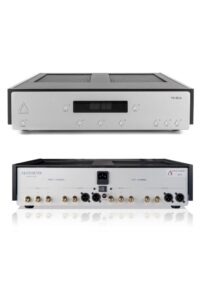
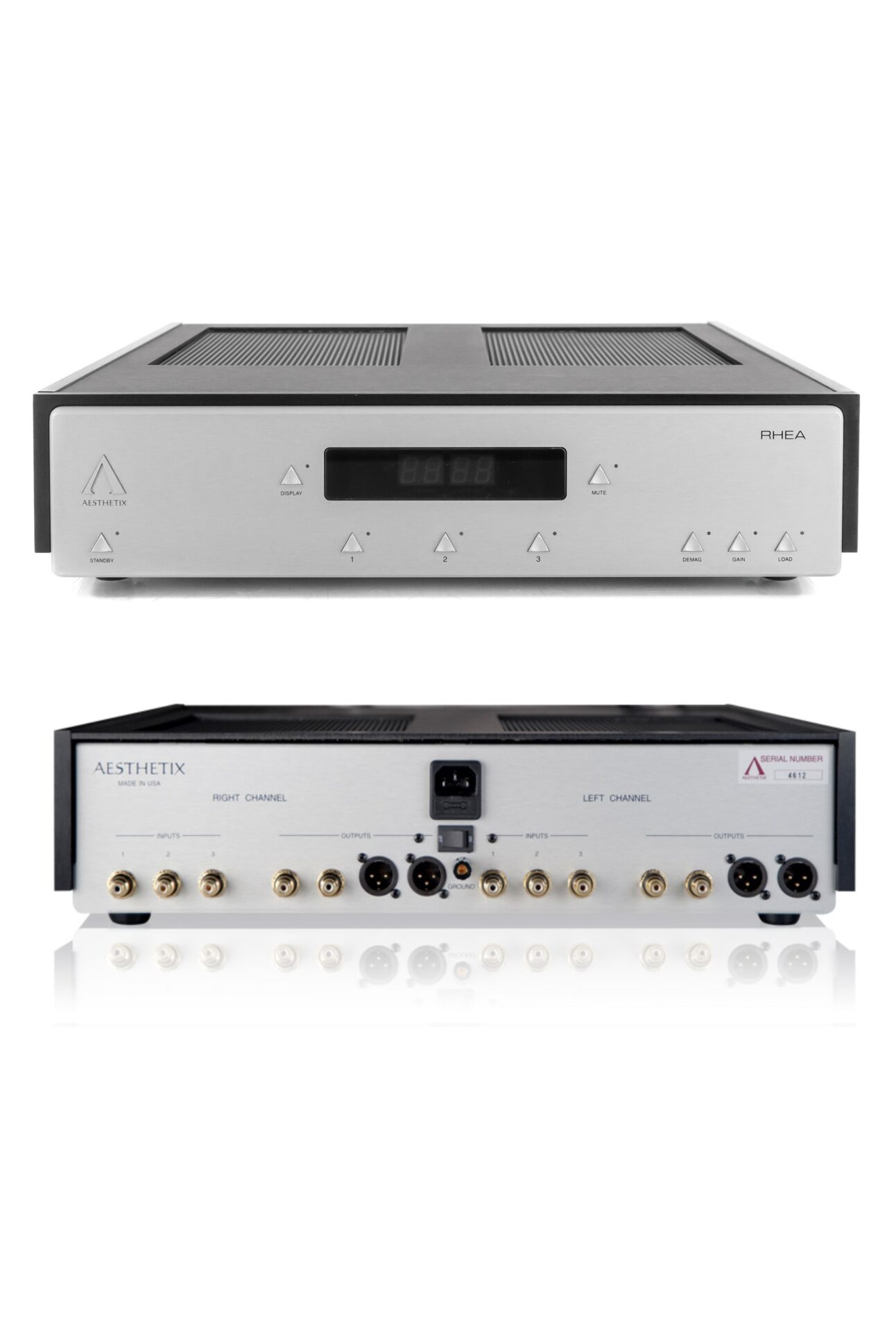
The standard and Signature versions of the Rhea share the same features and circuit topology. Both are slightly simplified versions of Aesthetix’s acclaimed Io phonostage. The unit features unbalanced inputs, with balanced inputs available for a small additional charge. The gain is adjustable in eight steps, with up to 75dB of gain at the maximum setting. Nine different cartridge loadings are provided. The gain and loading can be set independently for each channel. The way in which you adjust the gain and loading is very cool: Press the “Gain” button, for example, and the amount of gain in dB appears on the front-panel display. Simply push the right side of the display to increase the gain, or the left side to decrease it. The arrangement is the same for changing cartridge loading. In addition, you can adjust gain and loading from your listening seat via the supplied remote control.
The circuit is based on five tubes per channel, with two 12AX7LP tubes at the input operated in single-ended mode followed by a single 12AX7WB that functions as a phase splitter to create a balanced signal. The output of the 12AX7WB is filtered by a passive RIAA network, and then amplified by another 12AX7WB. The output buffer is a 6DJ8. Unique to the Signature version are variable capacitors in the passive RIAA network that allow each unit to be hand-calibrated for flat RIAA response. The variable gain and loading are realized with two separate switched-resistor networks.
The power supply is huge, and features all-discrete regulation (except for the supplies of the control and display circuits). The power transformers are mounted on an isolated substrate and encased in shielding.
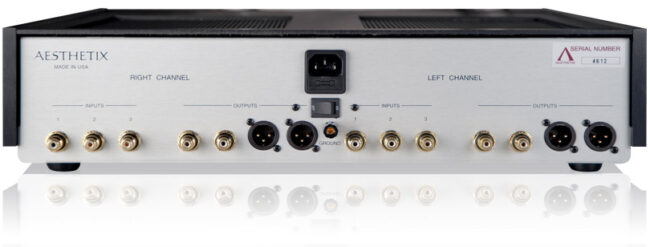
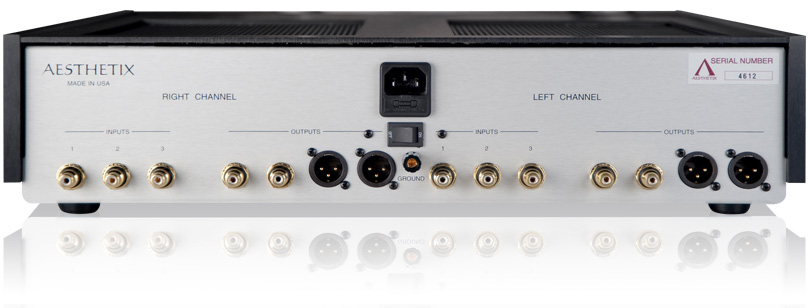
The metalwork, industrial design, interior layout, and build-quality are exemplary. Moreover, the feature set—three inputs, adjustable gain and loading via remote control, built-in cartridge demagnetizer, balanced outputs—makes the Rhea compatible with a wide range of systems.