
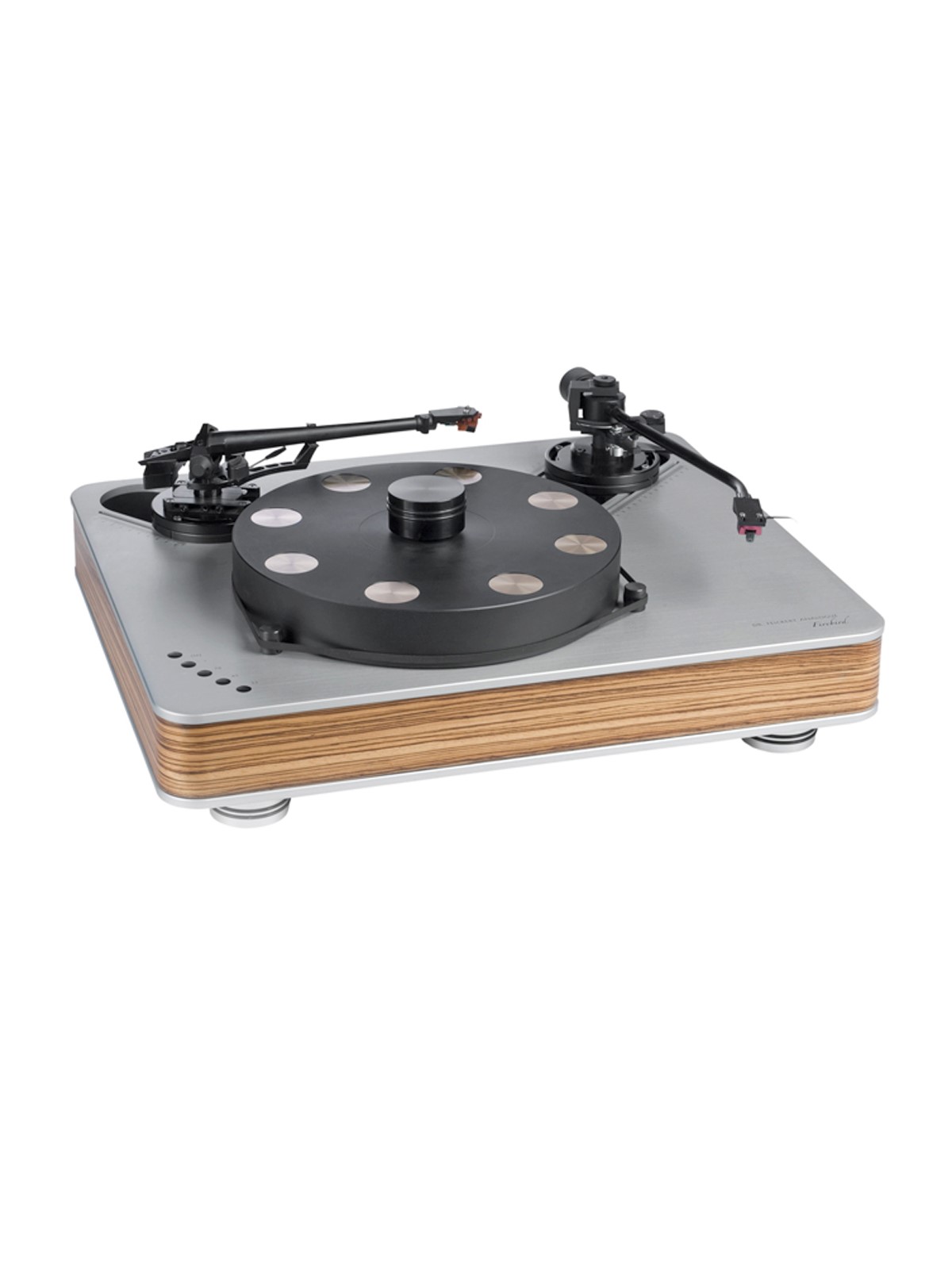

Dr. Feickert Analogue’s top-of-the line turntable, the Firebird ($12,500), is a generously sized record player designed to easily accommodate two 12″ tonearms. Its three brushless, three-phase DC motors, arranged around the platter in an equilateral triangle, are connected to a proprietary controller in a phase-locked loop (PLL); according to the Firebird’s designer, Dr. Christian Feickert, a reference signal from just one of the motors drives all three—thus one motor is the master while the other two are slaves. (Man, today that is politically incorrect, however descriptively accurate.) Feickert says that the key to this drive system is the motor design, which was done in close consultation with its manufacturer, Pabst. The result is a feedback-based system in which the controller produces the very low jitter levels claimed by Feickert.
A complete redesign of the inverted platter bearing used in the Firebird and in Feickert’s two other turntables, the Woodpecker and Blackbird, is claimed to reduce the contact area between spindle and bearing well by 80%, in order to reduce friction and, in turn, rumble, wow, and flutter. (Good thing: The original Blackbird, which I reviewed in my September 2011 column, wasn’t the quietest bird on the block.) Riding on the inverted bearing is a 13.23-lb platter of polyoxymethylene (POM), which is said to have resonance characteristics similar to those of vinyl itself; embedded within that platter, close to its outer edge, are eight solid brass cylinders. Feickert says that his three-motor arrangement, in which the platter is evenly driven by a thick, precision-ground belt made of nitrile butadiene rubber (NBR), results in a more stable bearing and platter by canceling out “virtually all acting forces,” to effectively eliminate bearing and platter wobble.
The Firebird weighs 68.5 lbs, and its plinth is large: 22″ wide by 6.25″ high by 18.25″ deep. Its thin upper and lower aluminum-alloy plates sandwich a block of treated MDF, and it sits on (newly designed) adjustable feet. The plinth is available in natural or black-anodized alloy, with side panels of zebrawood or piano-black lacquer.
Feickert’s arm-mounting system makes installing, adjusting, and swapping out tonearms more convenient than on many turntables. In each rear corner of the plinth is a large, oval, diagonally oriented cutout; the one on the right can accommodate arms with effective lengths of from 9″ to 14″, the one on the left arms of 9″ to 12″. Each cutout can be fitted with a circular armboard that bolts to a pair of sliding, captured nuts, one nut on each side of each cutout. A notch in the rim of the armboard aligns with a scale calibrated in millimeters and silkscreened on the plinth, for measuring the distance from the tonearm’s pivot to the center of the platter’s spindle—obviating, in most cases, any need for a pivot-to-spindle protractor. This makes swapping tonearms easy, assuming you’ve already mounted your other arms on Firebird armboards and that their pivots coincide with the centers of those armboards. Otherwise, as with tonearms that have off-center pivots—eg, the Kuzma 4Point, the Tri-Planar, and the Reed 3P—you’ll need to use a protractor capable of measuring pivot-to-spindle distance. Dr. Feickert Analogue, among others, makes such a protractor.
A single armboard is included in the Firebird’s price; to make use of the turntable’s second arm cutout, the user must add to it a Delrin “slider” ($100) and purchase an additional armboard ($125 each). The Firebird’s platter bearing is warranted for five years, everything else for two years.
Relatively Easy Setup
I placed the Firebird’s 68.5-lb plinth atop a Harmonic Resolution Systems isolation base, made sure that both base and plinth were level, then attached to the plinth’s underside the L-shaped mini-plug for the power supply. After applying to the bearing spindle a decent amount of the supplied lubricant, I carefully lowered the platter into place and waited for it to fully seat itself. That wait over, on went the belt. The only sticking point was getting the armboard bolts into those sliding metal nuts. It wasn’t easy, but only those who like to swap arms in and out will have to bother with it.
The Firebird can spin at 331/3, 45, and 78rpm; plus and minus buttons permit easy speed adjustment, if needed. The speed controller comes precalibrated, but I nonetheless checked it with Dr. Feickert Analogue’s PlatterSpeed software and 7″ test record. All three speeds were spot on, and remained so throughout my listening. See figs.1 and 2 to check out the measured results at 331/3rpm: They’re very good, and unusually symmetrical (perhaps because of the equilateral three-motor drive system?), though the low-pass-filtered trace (fig.2, wavy green line) seems to indicate the constant correcting action of the controller. Still, the filtered results look good, if not the best I’ve measured.