
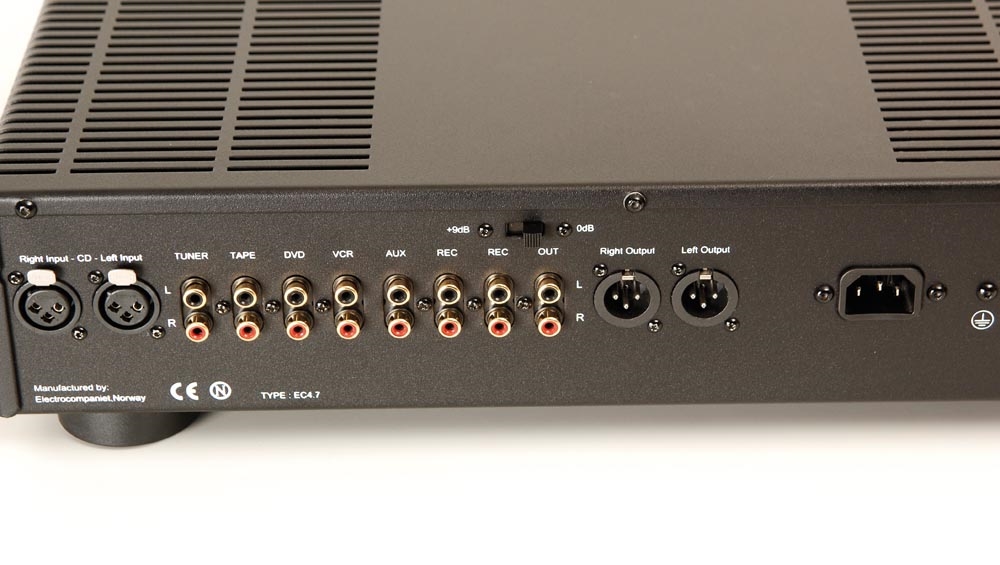

The Electrocompaniet EC 4.7 has all of the aforementioned sound characteristics and, when I used my analog front end and far more expensive reference digital equipment, showed that it was very clean and transparent, to boot. It is also exceptionally quiet and has significantly more extended bass and high-frequency response than many competing units. It is a very good preamp by any standard, and its price of $3495 makes it highly competitive.
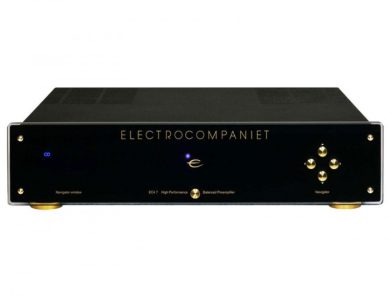
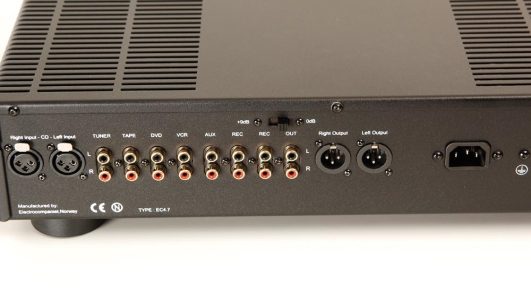
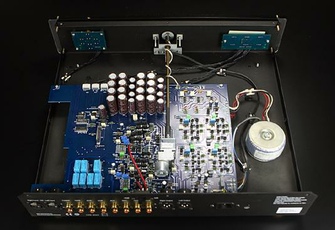
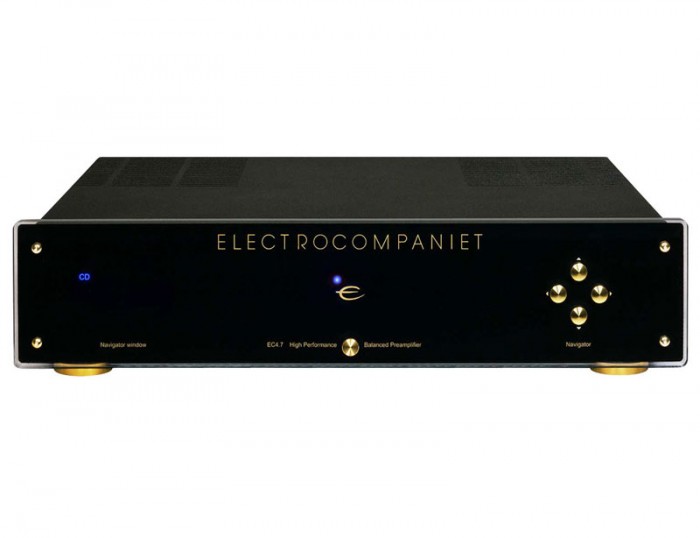
The EC 4.7 is a DC-coupled, fully balanced, remote-controlled preamplifier. It has one fully balanced and five single-ended inputs. There are one balanced and one single-ended line output and two fixed single-ended outputs for recording. Electrocompaniet states that the preamp’s motorized volume control was developed to “neither influence nor degrade the sonic performance of the EC 4.7.” Electrocompaniet also says, with a touch of Norwenglish, that “volume control and input sources can easily be navigated from the remote control, or via the Navigator touch buttons on the front panel. The Navigator window displays the selected source, and the volume position is indicated by a blue bar. The combination of a toroidal transformer and a reservoir of capacitance far beyond necessary will guarantee full control of your system. The EC 4.7 contains only high-quality discrete components.”
A word about “full control.” The styling of all three items of Electrocompaniet equipment is vaguely retro—gold lettering and finish on a push-button-driven set of controls with black panels and cabinets and fairly subdued blue lighting. The effect is stylish and distinctive, and the layout is intuitive enough that it takes all of three minutes to master the front-panel push-button features, particularly if you are hard-wired to never glance at an instruction manual.
Seriously, one friend of mine did complain for virtually all of the two minutes it took for him to get the control features right, simply because they were slightly different. If you are truly determined to be dense and inflexible, I should note that the remote control—which appears to be a rebranded video-electronics control that can be used for both the CD player and preamp—is labeled and laid out in the far more common Japenglish format, so an audiophile who is too rigid to learn new tricks doesn’t actually have to do so with the remote.
I am, however, going to make two serious complaints about the EC 4.7. First, I find I consistently need two balanced or XLR inputs to feed today’s digital and analog front ends. The EC 4.7 only has one. Second, the EC 4.7 also does not have a balance control, and this I find to be a serious defect. Dave Wilson pointed out in his reviewing days—before he got a real life making speakers—that a balance control should be called an “imaging control” because it has to be set just right for any given recording to lock in the soundstage, get the best depth and width, and make the imaging as realistic as possible.
I don’t buy audio equipment for simplicity, theory, or “purity” at the expense of musical realism, which is the general rationale for minimizing key control features. I fully recognize that some highly respected designers and manufacturers do feel such minimalism provides benefits worth their cost, and that other audiophiles do find such preamps fully satisfactory. I regularly, however, do adjust the balance control on my preamps to get the soundstage right, just as I adjust the volume to get the most musically natural sound, and I find a balance control to be essential. I would not buy a preamp or integrated amplifier without a balance control. Moreover, I have found that many top designers do get truly outstanding sound out of a preamp with such controls. To me, the absence of a balance control will always be a sign of design oversight, not design purity.